Speakers: David Fraher, President and CEO, and Anne Romens, Program Director, Arts Midwest
Question to us: What is your earliest arts experience?
(Mine is: Singing the complete Sound of Music soundtrack along with the phonograph from memory at age 3 and believing I was Julie Andrews!)
Who was nearby? Environment?
Starting point for today’s conversation:
We in the arts are in the business of making memories for ourselves and our audiences. Helping people connect with this creative experience, wonder and joy, that may be transformative in their lives. Maybe their first or formative artistic experience is how they remember their mother, a loved one, etc. We have to approach our work from this way…how do we not get in the way of this? We have to help them form these experiences.
Today’s conversation points:
A Need, New Insights, Messages that Matter, Keeping it Real, Explore Together.
From 1982 to now, there has been a precipitous decline in number of Americans who participate in (formal) benchmark arts activities (i.e., walking through doors to attend a play, a concert, go to an arts museum).
In 2012, the NEA started to track informal arts engagement (quilting, woodworking, practicing an instrument, singing in church choir, attending arts festivals, etc.) Guess what? 71% of Americans do this! So, the turnout is much higher than with formal events. What we are interested in is: there’s a 38% gap in between participation in formal events vs. informal events. Let’s view this not as a gap, but as an opportunity. How do we understand who these 38% are? Are they advocates for the (informal) arts they participate in? We don’t know.
Perennial challenge of making our case:
Arts and cultural funding is always threatened. Arts ed in schools and in the public sector (the NEA, for example) is a repeated battle. This conversation about this topic began because the arts organizations in the states that Arts Midwest serves lost 70% of their budgets in 2010-2012. They also lost 82% of the arts staff in those states. The funding has returned, but the staffing will never come back. Why? We know that AFA (Americans for the Arts) is a strong advocate, and many groups at local and state levels are fighting for funding. The arguments they make are effective when they go to the legislatures (state and local). But at the same time, who are the messengers? It’s the same 33% of the people who are making the messages – the arts makers themselves. The 38% more people who participate in informal arts experiences are not necessarily activated. We (Arts Midwest) wanted to change the equation. One of CEO David’s board members said, “There is a different way.” Thus they were introduced to the “Public Will” strategy: Let’s make art and culture a recognized, valued and expected part of everyday life, but read on, it’s not that simple…
Public Will Strategy:
This is a social change strategy that uses qualities of art like a hammer to try to convince people to participate in arts experiences using things that motivate people, given their values. This is what we usually try to do, but it fails. INSTEAD – ask, “What is it that you have within your movement, your issue, that aligns with THEIR values?” Rather than trying to get people to do what we want, let’s try something different: meet them where they are by giving them something they want.
The anti-smoking campaign was is a good example of a “hammer” (“public will”) strategy that was only successful after a transformation to align with people’s values. When the campaign started, people were told what was bad about smoking. Yet, they persisted to smoke for a long time. We didn’t get past smoking with just the Surgeon General’s warning – it was not convincing enough. Two values emerged that were needed to change people’s perceptions about smoking: 1) personal freedom (it’s my right to breathe clean air), and 2) an understanding of families’ desires to take their children into places where they can breathe clean air. Linked this to was research that secondhand smoke is as dangerous as smoking. Then this info was provided to PTA’s, schools, community organizations, local government, etc., and the regulations followed. And smoking rates decreased dramatically.
Within the public perception about smoking, there has been a change in normative social expectation. Our expectation of all spaces now is that they are all smoke free. We react very negatively to it now because our expectation of a smoke-free environment is deeply held. Can we expect the same – a new normative social expectation – for the arts?
Another example: Libraries. 20 years ago they were falling in disrepair. Limited hours, buildings in need of repair, staff getting laid off. People said, “we don’t need libraries anymore.” Libraries were facing the same kinds of challenges as arts organizations face now. Libraries then realized that people were looking for “places of opportunity,” where they could login and look at the internet, where they could print documents cheaply, participate in social activities, learn languages, attend classes. Libraries repositioned themselves. They used to be temples or repositories of books…now they are welcoming, opportunity-based locations. They are physically very different, they have a different vibe. More people in the US went to libraries last year then went to all major sports events combined. Libraries have a base of support among communities. For example, bond issues are coming forth, and new libraries are being built all over the Twin Cities now.
Can we change arts organizations to become places where the normative social expectation is that the arts will be here for the long term? That arts will be in the public schools? In order for this to happen, they have to align with people’s values.
How do we do this?
We need to understand what the public values, what is most important in people’s lives. The Arts Midwest took up this question a few years ago. The question is not “why are the ARTS important to you,” because that’s a presumptive question, but rather, “WHAT is most important to you?” Their study used a diverse sample of 2000 individuals, and data was obtained by survey, focus groups, and executive interviews (there is more info on the study – details available). The question became: what is the most important to you in general?
So, what IS most important to people? The core value, determined through the national survey done through Arts Midwest, is connection. People value connecting with themselves, friends and family, with their culture, with new ideas.
So after they found out what was most important to people, the next question was: “How important was this to you personally?”
Answers:
- Family, 64%
- Health and Well-Being, 52%
- Faith, 40%
- Children and Youth 40%
- Education
How important are each of the following activities to you personally?
- Doing things with your children or family, 65%
- Attending a live performance, 19%
- Visiting a museum or gallery 17%
- Making or creating art 17%
- Attending an art or music festival 16%.
(The first one, referring to “children and family,” is a general recommendation – the resonant relationships are with any family members – not just children).
Creative Expression is a more engaging and powerful frame than “arts and culture.”
Imagine: There is a door and it says “arts and culture.” A percentage of people will go in that door, but it will be 16-17%. Maybe these people were encouraged in the arts as children. What about everyone else, who may not have experience with the arts, or who were rejected from arts activities as children? Frame the art activity instead as “creative experience” or “creative expression.” Don’t start the conversation with “arts and culture,” because it’s not one of the 38%’s values – although you can go there eventually (the doors go to the same place).
Facts and Figures: The study said that most people believed they would be happier, healthier and less stressed if they were more active creatively. Also, the benefits of arts and culture to children and youth are valued most highly.
If we had more opportunity to express or experience arts and culture, what would be different? People said (in order of preference):
- Children and youth would build the skills they needs in life.
- We would better appreciate cultural diversity.
- We would be happier, healthier, and less stressed.
- We would have a better understanding of ourselves and each other.
- We would have a stronger sense of community.
- We would have more fun.
- (Last was: Our economy would be stronger. This matters to the city council, to the people who are making budget decisions, but it DOESN’T matter to most people.)
This is where we get into a sticky situation with our arts advocacy messages. If you are trying to motivate the 33% or 38%, go with the values that were the strongest, above.
Audiences: Who is most likely to say that they value the statements above?
- younger people (millenials)
- women
- parents of children under 18
- people of color
are the people who have these values. This cuts across all these groups when looking at their perceived importance of various activities: by color, by age, by gender expression, by parental status (people with kids under the age of 18 living at home). They ALL hold these values most dear and are more likely to participate in creative expression. This is all national data.
Another data set but regional this time – (audiences) from Massachussetts:
Group 1: 15% (women, people of color, people under the age 35, college-educated, minors living at home) hold three values strongly: 1) believe its important to engage in arts and culture, 2) often get the chance to engage in arts and culture, and 3) want to engage more often.
Group 2: 42% (similar demographics and values to group 1)
Group 3: 19% (over-50 crowd, higher household income, no kids living at home, but race, age, gender mirrors the rest of population) is third most active/desiring of creative expression, and holding similar values to groups 1 and 2
Group 4: 24% (older white men) is fourth most likely.
BUT all groups aspire to engage in MORE creative expression at SOME level.
The further to the left (the closer to Group 1) on the segmentation spectrum, the more likely someone is to: want to lead a healthier life, more concerned about the enviroment, they are more likely to try new technology.
The power of formative arts experiences: 98% of Group 1 was encouraged to be creative or use their imaginations in childhood. 76% of Group 2. Only 31% of Group 4 individuals were encouraged!
So the closer to Group 1 individuals are, the more likely they are to say that they are more comfortable partcipating in artistic or cultural events or activities. Barriers to comfortable arts participation – you don’t feel welcome walking in those doors. The more likely they are to want to share and interact of actively engage in arts and cultural experiences.
After taking the survey, participants were asked: How likely are you to do these things (participate in an arts activity) in the next 12 months:
Just the act of taking the survey increased their likelihood of participating in arts in the next year! The power of seeing these messages in the survey had an effect on all groups’ willingness to do the following: pick back up a creative hobby or activity, sign a petition, take lessons or study something creative, create art themselves, visit a museum or gallery, attend a live theater or dance performance.
Barriers: time and money. Arts are viewed as a “nicety” or luxury. People want to engage with arts and culture, but are still finding mostly opportunities to passively observe. Later barriers are: distance, geography, no one to do it with (if you don’t have someone to go with you, you are less likely to go), not a priority in my everyday life, etc.
Connection is the core value. Creativity or creative expression are more welcoming terms to use when inviting people to your activity. People believe they will be happier, healthier, and less stressed if they participate in a creative expression event/activity. People of color, women, millenials, and people with children under 18 are most likely to engage in creative expression because the arts share their values. Money and time are barriers – we have not found a way around these. People also don’t feel comfortable walking in the door. Comfort is a perceived barrier. We need interactive, socially-based arts experiences to connect with our audiences and make events creatively expression. Not everything an organization does, however, has to be interactive (you don’t need to invite them up on stage to sing and dance).
Arts Midwest asks us to ask ourselves, do our audience members feel comfortable here? Begin with your webpage, go through to the event, the end of the event, to departing. Think wholistically. What are the barriers?
Practical ideas:
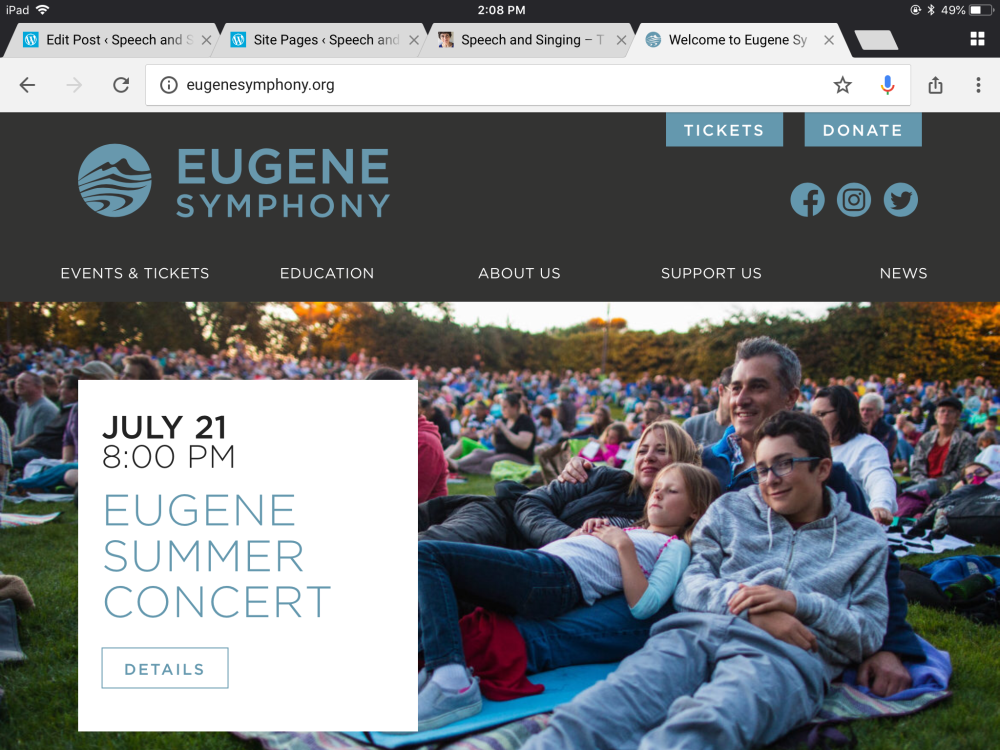
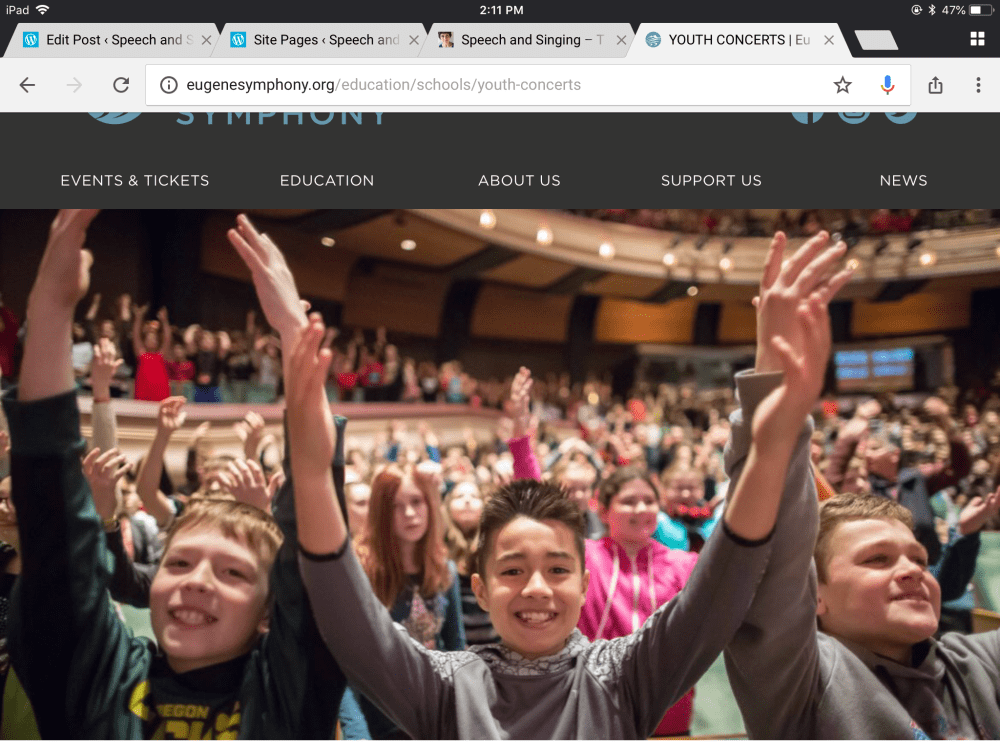
Feature our audience having meaningful experiences with our art – in other words, feature the audience experience on our media. This could include photos of the people in the audience, or unsolicited praise we’ve heard via email or social media, or sent to Mark or Gail. An example from a theater in Redwing, MN: “OkGo was awesome! Thank you. The band was awesome, the theater was awesome….” And the comment went on and on from there. Take home: We need to use the language that people use to describe their own experiences in our marketing, rather than our own “formal” (depersonalized) language. LET the AUDIENCE speak, instead of showing us speaking about ourselves.
(Aside from me: Do we have a disclaimer when people buy tickets that we may use a photo of them or their words on our webpage?)
Another idea: Use a white board with pens in the lobby so that people can write what they feel about the concert experience they just had. Eugene Symphony does this, and it becomes sort of its own art installation.
Another idea: Place an iPad in the lobby to capture an image of themselves and why they came. Then feature the photos on the webpage.
The San Jose Symphony tried an “A” and “B” test with marketing. They tried the traditional marketing video (focused on the artists, the season, etc)., and another version in which they created a video focused on the audience experiences. They they tracked the number of click throughs/purchases, and the audience-focused version was the most successful. Here’s the video of the one that focused on the audience experience (which was much more successful):
https://summerfest.sanjosejazz.org/videos
 Speech and Singing