Chorus America Virtual Conference: June 17, 2020, 3-4pm
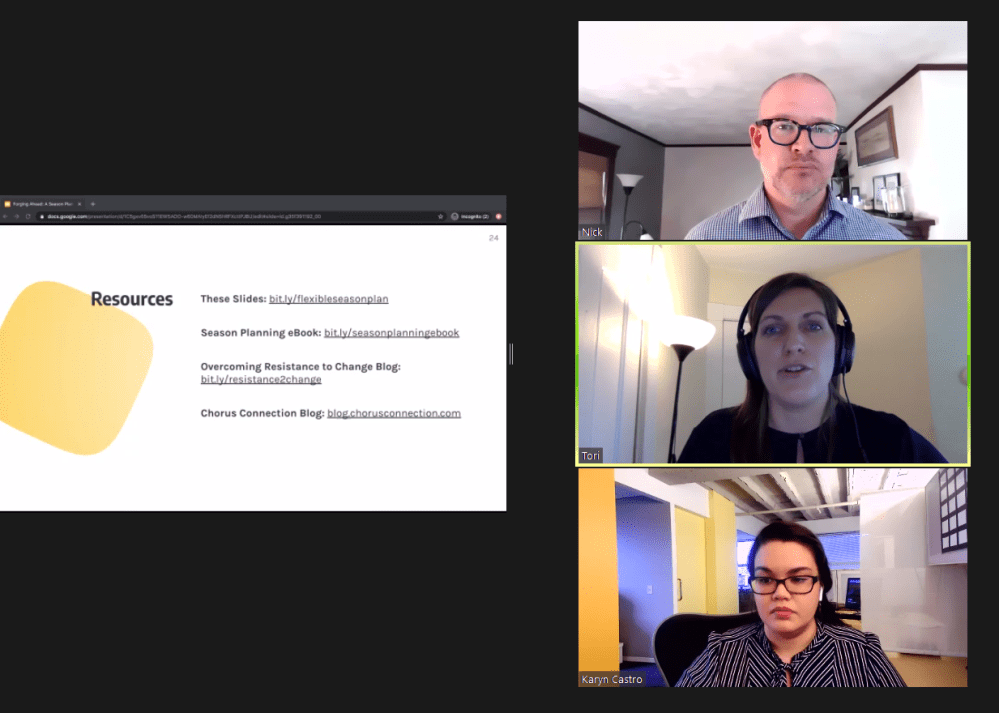
Speakers:
- Tori Cook, Director of Sales & Marketing at Chorus Connection, expands on the key takeaways from her recent and viral ebook:
- “What Does Season Planning Look Like Amidst COVID-19?”
- Tori is joined by Executive Director of Cantata Singers, Nick Adams, who will present on how his organization is using the concepts in the ebook to forge ahead.
Together, they presented a variety of different models and frameworks that choruses can use to plan for their upcoming season with a focus on breaking down pre-existing cultural expectations around season planning and helping choruses move towards a mindset of flexibility and adaptability in the coming year.
Tori: Introduction and e-Book Takeaways
-
The risk was never zero. We have always assumed some risk. Determine as an org what risks you are willing to take on.
- Nick: I am sitting on a committee in Boston organized by the mayor to talk about re-opening. Prevailing wisdom in Boston is that the orgs that are going to open are going to have to figure out what risk they are willing to take on, even with recommendations from the medical community.
-
Look at your mission.
- Performing is what we do, not why we do it. So we are going to have to figure out how we can best deliver that value to people. The ebook will talk you through this.
Tori: 5 ways to set yourself up for success in the year ahead (we’ll talk about the first 3 today in the webinar)
- Learn to adapt quickly
- Aim for flexibility
- Be willing to experiment
- Ask for help
- Don’t give up
Arbitrary rules that we’ve made up:
- “We must formally announce our full season this summer.”
- why do you do a season subscription model?
- does it really, really work for you?
- what are the alternatives? have you really considered them?
- “We need to plan x number of concerts.”
- what if you changed the number of concerts that you offer?
- do what makes sense to you
- try to remove yourself from the limitations you have set on yourself in the past
- “We need x amount of time/rehearsals for a concert.”
- Choose past repertoire, easy repertoire
- Can you plan a concert in a couple days, a couple weeks
- Potentially we are not going to know if we could sing again until right before it happens, so if there is a window, and you are not ready, you may miss it!
- “We need x amount of singers for each concert.”
- Think about this differently because of capacity limitations and health/safety regulations
- Don’t limit yourself to what you have done in the past
- “Every singer has to perform at every concert.”
- What if you have Group A, B, C, and each one sings a different night?
- Experiment with half-membership by semester or by concert as you consider the year.
- “We’re on our own.”
- Usually choruses look at their community and are always trying to distinguish themselves from the other choruses. We are competitive instead of supporting.
- We need to come out of this on the other end with choral music still in existence.
- We need to reach out to other organizations if we are foundering, or accept their queries if they are and try to help them.
Nick: At Boston Cantata Singers, the March concert was a couple days away when Boston shut down for the pandemic. The concert was lost two days later, and then the rest of the season. We then did whatever we could to keep pressing on with plans for the next year. Then we received a message that their venue was cancelling rentals through the summer. All the plans were BLOWN UP. While we absorbed the news and grieved it, we started learning, innovation, and pivoting. BAU is not normal or expected; we need to learn how to play this new game as quickly as possible. Develop a posture of readying, embrace being flexible and adaptable. These are good things to do even in normal times!
Tori: If you find yourself trapped in the old mindset, “Blow. It. Up.” Abandon any thinking on best practices as none of us have been in this situation before. All we can do is try things, and share what we learn with the community. If you find yourself doing the same thing you’ve always done before, you are NOT adapting. None of the traditional things that I do in my administrative role are making sense now – mailing things, depositing checks, etc!
Flexibility in Practice:
Easily and quickly modify something to turn on a dime, and be WILLING to change.
General Rules of Flexibility:
- Ignore pre-existing expectations
- Get comfortable with change (look for Tori’s blog on this)
- Allow for experimentation, risk-taking, and failure.
- Some of the most successful companies CELEBRATE failing.
- It often comes with a negative connotation, but we need to reframe how our boards and people think of failure.
- It frees the organization up to try new things and opens the mind.
Nick: the Cantata Singers are going to experiment with empowering our SINGERS to be innovative and lead the way in creating artistic content. By losing the concerts in the hall, they had to lower the expectation of ticket revenue to ZERO. In light of that, we wanted to make our artistic product as lean and inventive as possible. We are looking at placing our money (meaning granting our singers money) for innovative projects that further our mission and are adaptable to these times.
- Let yourself lose control – we cannot control everything!
- Control what you can, and accept what you can’t.
Nick: this happened with our gala. A large in-person event was scheduled for April 4, which generates 10% of our annual budget. It was cancelled, obviously. First, the discussion became “how far out can we schedule this event and have it still happen in this fiscal year?” Then the board led the way and said, we need to make the decision now to pivot to a virtual event. (Nick was reluctant! For the last 10 years, Nick has done in-person events.) But they learned, and partnered with an auctioneer and a TV station, pulling in videos from the education program and the singers. They put together a 45-minute virtual gala. Even though they didn’t *quite* make the revenue that they were hoping for, they learned was that this was a viable way forward. They are planning to do it again in June ’21. Moral: Be in a posture of readiness!
- Streamline NOW
- in Tori’s blog, she talks a lot about this, because she likes working on creative things and not admin work
- it’s especially important in the year ahead, when we have LESS time than typical for the manual labor.
- Get rid of your bottlenecks
- Get rid of your access barriers
- Open access to committees and teams!
- Open up passwords. Get your passwords where people can get to them.
- You can’t have one person holding up the process.
- Stop doing the things that take a lot of manual labor
- data entry, etc
- anything that will help you automate that manual labor is good!
- Stop making excuses about why you can’t change
- (i.e. “someone’s feelings will get hurt”)
- Use the pandemic as the reason for why things need to change, and do it!
- Get over our own issues.
- You have 100s of opinions to deal with.
- Managing feelings and conflict resolution takes too much time. Let the drama go.
- Let the opinions go about everything that you did and should be doing.
- Tori: I think if everyone did this, we would be quick and better at making decisions.
How Boards Can Be More Flexible:
- Non-profits function with a very hierarchical decision making structure.
- Get out of the weeds.
- Set the overall budget and then let that decision stand
- Avoid going back to the board for individual items of spending.
- Try the concept of “modular budget”
- i.e. here’s the overall year budget, here’s where we need to end up the year.
- Then let’s budget for each module. Then those modules will not need to be approved because the board approved the overall budget.
Nick: Cantata Singers are working with 4 budgets, organized quarterly, because we don’t know what next year will look like. They are making decisions on how to use it and then make adjustments. It doesn’t work to think about budgeting for the whole year. Think of it in chunks, quarterly budgets, reviewed monthly, by the financial people.
- Set up a better decision-making structure.
- Assign goals, not roles.
- Abandon committee decisions – it’s just too slow.
- Give authority to decision makers (without having to get board approval).
- Establish feedback points.
- Buy-in is important, but too much of it slows down the process
- i.e. at the start of the project, accept feedback, but give a closing date
- then announce that you will accept feedback at the end of the project.
- Gather data but go with your gut. There’s not enough data to make perfect decisions. Trust your organization.
- Buy-in is important, but too much of it slows down the process
Rules of Flexibility for Artistic Staff:
- Program something that can be put together quickly.
Nick: we hope to be singing together relatively soon, whether indoors with masks, outdoors, etc. We are hoping to build a reserve of musical content. Think of artistic planning as building your “quiver” of “artistic arrows.” Once we have a reservoir, this repertoire can be used in any way/shape/form (video, live performance, etc.). This is as opposed to the normal model, rehearse for 8 weeks in a monolithic chorus, etc. That’s just not going to work!
- Don’t put yourself in a box: Experiment, not everything has to be perfect.
- Be okay with informal and imperfect.
- We strive to have artistic excellence, but that’s going to be hard when we need to do quick planning and turn-around.
- Let the imperfections go. Be OK with a more informal setting.
Nick: Focus on the process and not the product. We have an extraordinary opportunity to demonstrate the humanity in music making. As in, “We will experiment, we will sing in masks, socially distanced, just to have the chance to sing together and bring the humanity of singing to our audience.” One Cantata Singers member recently brought forth the experience of singing the Faure Requiem outside in a mask and reported that it was a unexpectedly fulfilling and moving experience.
Tori: in one year, are we going to be disappointed that we didn’t try something? Think about how you will feel about what you do.
Planning:
Cantata Singers Sample model:
- Summer Sings: outdoor, social distancing, capture everything! In the next few weeks, we will do this! Who knows what this will look like and sound like. We will have video cameras and phones out, we want to capture the singers sneaking out, tip-toeing out to try to sing together!
- Digital Event in the Fall: YouTube Live hosted event with special projects. Whether we use a virtual or a real setting – this is something we might use to kick off our season.
- Virtual Chorus/ Digital Event tailored to the year-end “ask” – maybe something around the education program (which has pivoted online)
- Virtual Gala (again): it proved to be such a viable option, that Nick can’t imagine going back exclusively to the live event. The amount of staff time that it takes is MUCH REDUCED. It was a 45- minute event. It’s too viable not to do!
- Lecture Recital: Depending on the venue, experiment with small audience? Take the series that we are used to producing and add some educational components. Maybe the singers will sing a piece and talk about it (could be digitally captured and then presented, or if things are looking more promising, then maybe a small audience.
- In-Person Concert: small audience (socially distanced as necessary), live-streamed, and recorded in a high-quality way so that you can brand it for future marketing.
Sample Models – see Tori’s slides (p 21-22) bit.ly/flexibleseasonplan
 Speech and Singing
Really good stuff here! Thanks Jane!
Sent from my iPhone
LikeLike