JUNE 16, 2020, 3:00 PM
With Ms. Alysia Lee and Kara Morrissey
Sister Cities Girlchoir
Using The Washington Chorus’s (TWC) own recent artistic director search as fodder for learning, search chair Kara Morrissey is joined by equity and bias awareness consultant Alysia Lee for a behind the scenes look at how TWC worked to center bias awareness, equity, diversity, and inclusion in all parts of its search process. This session will begin as a case study review highlighting the lessons of TWC’s search process that are applicable for choruses of all sizes and types. Participants will learn about why bias awareness and DEI centering matters in all your chorus’s hiring processes, and leave with concrete steps your chorus can take now to improve its work and impact in this space.
Alisia Lee:
“Never doubt that a small group of thoughtful, committed citizens can change the world; indeed, it’s the only thing that ever has.”
-Margaret Mead“Not everything that is faced can be changed, but nothing can be changed until it is faced.”
-James Baldwin
Traditional Hiring:
Two Steps:
- Recruitment
- Hiring
Updated Hiring:
FIVE Steps:
- Organization Knowledge
- Analyzing industry and organization data
- Building intentionally diverse relationships
- Impact and visionary expectations for the position
- Position Description – we know people who are conductors in classical music are traditionally white and male; bring in some other eyes to look and see, are we gendering the language? Are we implying skin color? How is this bias showing up in our position description?
- Evaluating position requirements {educational, experiences, and physical requirements)
- Mitigate any unintended consequences or disproportionate impacts
- Update Position Description
- Recruitment – rely on your relationships in the community; make sure that pool of candidates is DIVERSE; share into NEW NETWORKS!
- Engage a wide variety of diverse stakeholder groups.
- Post the position internally/externally to minimize unintended consequences and disproportionate impacts.
- Interview Questions
- Prepare tangible benchmarks for interview questions.
-
“compare them to the data that you have, place those topics in buckets and develop a question around each topic; include questions that consider equity and social justice; if this is already woven into your organization, then it is naturally a part of your interview process.”
-
- Include question/s regarding equity and social justice
- Prepare tangible benchmarks for interview questions.
- Interview & Selection
- Create a diverse resume review /interview panel.
- Incorporate debrief sessions after each interview.
- Hire the best candidate, not the candidate with the
best scores.
A recent Harvard Business Review article stated that:
- the odds of hiring a woman were 79.14X greater if there was another woman in the pool of candidates!
- the odds of hiring a minority were 193.72X greater if there were two minority candidates in the pool!
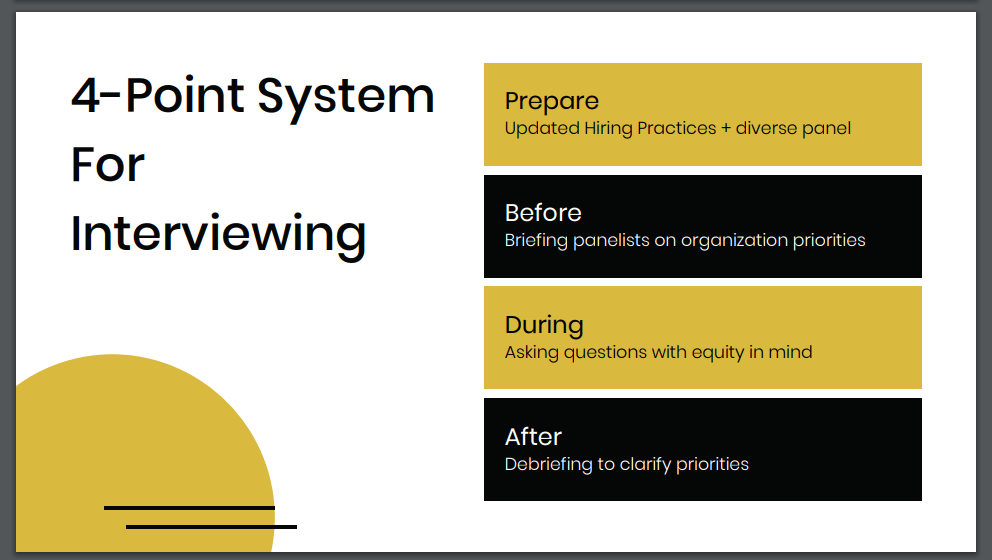
Before: DO A brief bias training! Place people on your interview team who are diverse, maybe from OUTSIDE your board.
During: Set up a rubric of questions. Forget about top of mind, unplanned zinger questions – it’s not a game show! Allow your candidates to show up with WELL PREPARED ANSWERS to QUESTIONS. We want to know how the person think about things in deep ways. We want to know that the answers that a person gave are the totality of what they have to offer. We will potentially be with this person for YEARS!
After: Prepare someone to lead a 15-minute REFLECTION (curated review questions) about each candidate and use another rubric for this, so you can compare the candidates across a level playing field. Use very central, guided points of inquiry around the candidates. Review and reflection questions need to be the same for each candidate. Then allow your hiring committee to score the candidates. This discussion allows people to recenter on the GROUP need, rather than making decisions based on personal opinion.
Kara:
Hiring a new AD at the Washington Chorus: Our committee was formed in June, 2019, and we solicited applications for the position of Artistic Director (our 5th in our history) in January. The hiring was complete about a year after the first meeting (so just now).
Initially, a year ago, 4 members of the hiring committee met with Alysia to implement her practices around centering DEI in our hiring of our new Artistic Director. The Position Description was developed using these, and shared with board, singers, committee. The hiring committee also had all stakeholders read a few articles about bias in hiring.
In the interview process: To be honest, at first, the hiring committee reacted a bit negatively to the idea that the candidate would get the interview questions in advance. In the end, however, they were complete believers in the process!
Kara was the leader for the interviews and used a strict order for questions and people asking them. Each candidate was given the same amount of time. The committee applied the same process for the questions that were asked of the candidates in front of the chorus, during a rehearsal. The committee did a survey after the rehearsal interview with all the singers, and used the same questions for each evaluation. They next chose semi-finalists and then two finalists. The committee was satisfied that the process was working when 40% of our candidates throughout the process were women or people of color. Towards the end of the process, they felt that our hiring committee was not diverse enough, and they added people to it. There were new questions added following the addition of the new members, such as:
Has there ever been a time when you thought you needed to change your behavior at work? Did you? How did you do it?
What do you see as the fundamental characteristics of organizations that create inclusive environments? What have you done to create inclusive environments?
The feedback following the interview process from every candidate was gratitude for how thorough and thoughtful the committee’s questions were. All of the candidates thanked us for engaging, rich, and meaningful interviews. Even the committee members who were initially resistant to this type of interviewing were on board with it. This process changed The Washington Chorus for the better. The payoff was that at the end of the process, they had a unanimous committee vote and a unanimous board vote for the finalist for the position! They were thrilled at this appointment, but even more thrilled about the process. The Washington Chorus also knew as a result of the process that they had a lot more work to do around DEI, and they will stay in touch with Alysia.
Alysia: Q&A
What about the hiring of an administrative position?
Recommended resources from the panel:
https://hbr.org/2016/04/how-to-take-the-bias-out-of-interviews
https://hbr.org/2016/02/7-rules-for-job-interview-questions-that-result-in-great-hires
 Speech and Singing